New Zealand's health system is under strain, and the cost of caring for an ageing population is rising. If we keep doing what we've always done, we shouldn't expect better results. To keep quality care within reach of every New Zealander, something has to change, and that includes how we plan and pay for care in later life.

The independent Aged Care Ministerial Advisory Group in New Zealand released its final report, A place to grow old: Securing the future of aged care, August 17, 2026. Chaired by Hon David Cunliffe, the report warns that New Zealand's current aged care system is fragmented, underfunded, and rapidly approaching a crisis.
Proposed aged care reforms could ask people with means to pay more. Here is what that could mean for a couple aged 65 and 69 with a $1.5 million Auckland home and $500,000 invested.
Meet Helen and Graham
Helen is 65 and Graham is 69. They own a $1.5 million Auckland home and hold a $500,000 portfolio that pays about $15,000 a year. With NZ Super of about $51,200 between them, their income is roughly $66,200 before tax.
Retirement spending plans often assume spending drifts down by around 2% a year in real terms. Care costs don’t follow that script.
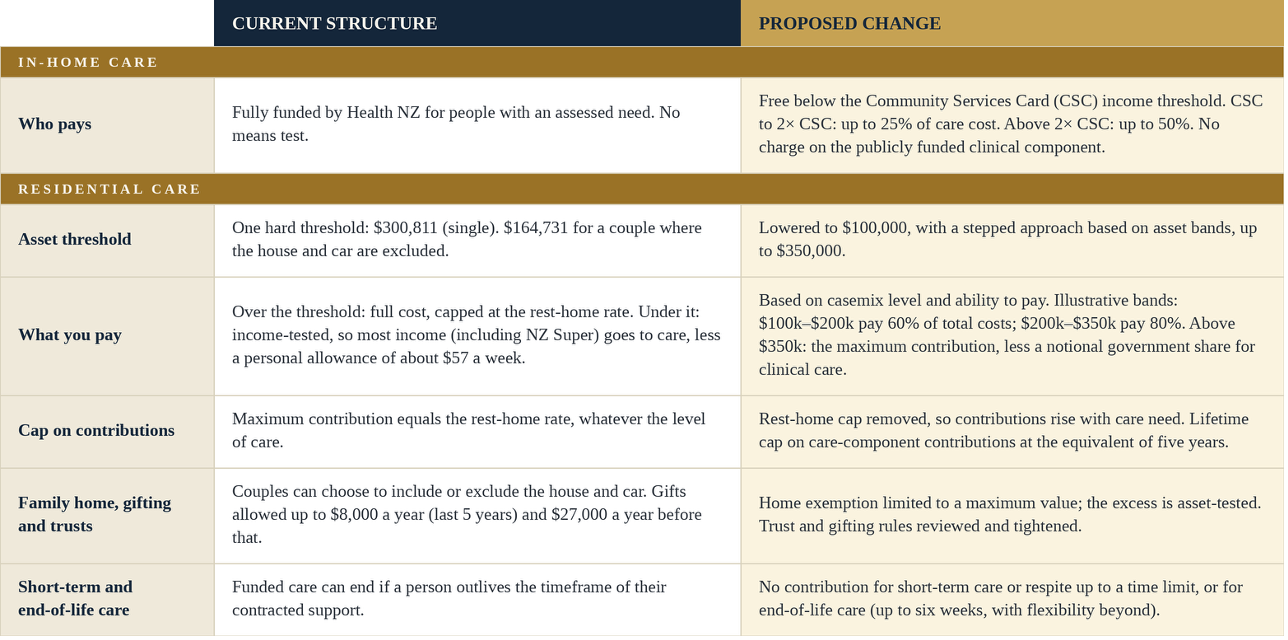
Current structure vs proposed changes

At home: a new bill could appear
Today, in-home care is fully funded, whatever your income. The Ministerial Advisory Group proposes keeping it free below the Community Services Card (CSC) income limit, which is $59,694 for a couple on NZ Super. Above that, people would pay up to 25% of care costs, and up to 50% above twice the limit.
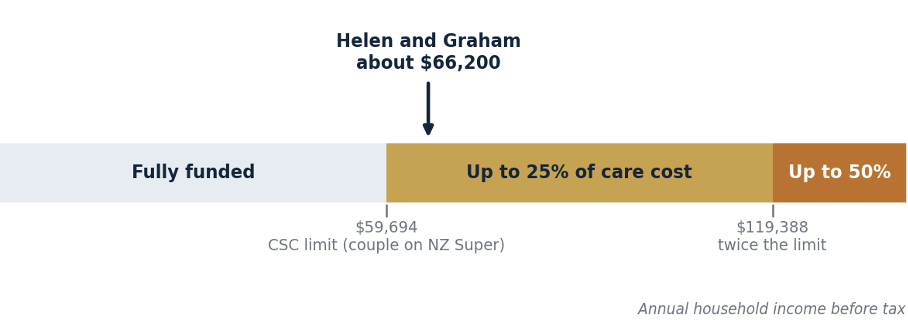
Illustration of the proposed in-home care bands against the couple’s income.
The report expects most people aged 75 and over would not pay under these settings. Helen and Graham, at about $66,200, sit roughly $6,500 over the line. How the $15,000 is classified could matter: the CSC counts only half of a private pension, but investment income counts.
In care: the ceiling lifts, cap on contributions removed
Today, with assets well above the threshold, a resident pays the full cost only up to a maximum contribution set at the rest-home rate, whatever care they need. From 1 July 2026 that is $1,634.43 a week in Auckland City: about $233 a day, or $85,000 a year. The report proposes removing that cap, so contributions rise with care needs, less a notional government share for clinical care.
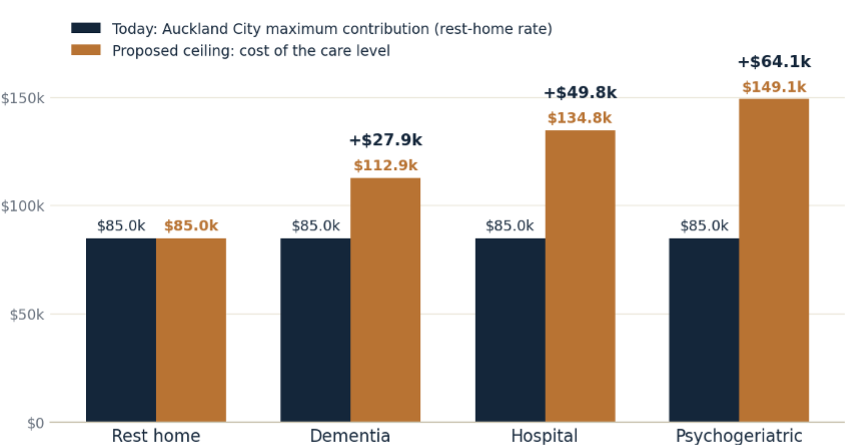
Today’s bar is the 1 July 2026 Auckland City rate. The proposed ceiling is an Athena illustration, before the government’s notional clinical share.
Before that share, dementia-level care could cost about $28,000 a year more than today, and hospital-level about $50,000.
Residential care facilities that have a contract with the government, provide lifestyle, accommodation services and health professional services.
Lifestyle services
Lifestyle services to help with your everyday needs:
healthy meals and snacks — as much as possible they should take account of your personal tastes, and medical or cultural needs
laundry and cleaning services
equipment that helps you get around, such as wheelchairs or walking frames
clinical or other equipment that helps with your personal care — this ranges from thermometers and stethoscopes to hospital beds and hand rails
some recreational activities
radio, television and mail services.
Accommodation services
Residential care homes and hospitals also need to provide:
accommodation that is suitable for older people — it must be comfortable, safe, offer privacy, and support your wellbeing
a garden or safe outdoor space that has sheltered seating and is easy to get to.
Health professional services
Services provided by health professionals or those they supervise:
visits from a General Practitioner (GP) — this is usually a doctor they appoint to look after you
medicines that are prescribed for you by your GP — but only those that are subsidised by the government agency, Pharmac
nursing care — this includes having a registered nurse available to oversee your care
dressings, continence supplies or other products used in your treatment
transport for medical or health reasons, for example, to and from an appointment at a public hospital
someone to accompany you to health appointments — if your family or friends are not able to.
Two protections would help:
a five-year cap on contributions to the health professional services or care component by the individual
no charge for short-term care, respite or end-of-life care (up to six weeks).
For this couple, the portfolio alone puts them above the $350,000 level where maximum contributions apply, so the proposed cap on the home exemption changes little. The report has not set the cap’s level.
What to budget for
• A care reserve. Three years of hospital-level care at the proposed ceiling would cost about $150,000 more than today’s cap.
• In-home co-payments. Allow for up to 25% of care costs, and know which side of the CSC line you are on.
• Extras. Contributions cover the regulated standard room only, and just 47% of beds nationally have no additional charges.
• Gifting and trusts. Today’s gift limit is $8,000 a year over the last five years, and the rules may tighten. Get advice before restructuring.
• Documents. Keep wills and enduring powers of attorney current.
What happens next
These are recommendations, not law, and the report calls them interim. It assumes the changes start in 2028/29, with residential changes phased in over three years, when Graham would be about 71. The time to test your plan is before the settings are confirmed.
Want to see how this looks for your own plan?
Let’s talk the proposed changes and likely reality og the future of healthcare together. Get in touch with Sumita Paul for a conversation about your retirement lifestyle.
Source: Ministerial Advisory Group on Aged Care, A place to grow old: Securing the future of aged care, August 2026. NZ Super and CSC figures: Work and Income, 1 April 2026. Helen and Graham are fictional, and the figures are Athena Wealth illustrations at today’s prices, not forecasts. The recommendations described are proposals to government, not current law.
Important information: This article provides general information only and does not take into account your personal circumstances. It is not financial advice. Please speak with an Athena Wealth adviser before making any financial decisions.