
The Fortnight Nobody Prepares You For: money admin after your partner dies
Most couples spend years building a shared rhythm around money — one person pays the power bill, the other knows where the insurance papers are; one keeps an eye on the bank accounts, the other remembers the KiwiSaver login. When your partner dies, that rhythm can stop overnight. Alongside the grief, there is suddenly a quieter, practical question: what has to be done now, and what can wait? This guide is for that tender first fortnight — not to rush you, but to give you a calm place to start.

When your partner dies, the first fortnight can feel unreal. There is grief, shock, family to contact, a funeral or tangi to organise — and, quietly in the background, the money admin starts arriving too. Banks, insurers, utilities, government agencies, KiwiSaver providers, lawyers, passwords, bills, certificates. It can feel like a second loss: the loss of the person who knew how everything worked.
The most important thing to know is this: you do not have to settle the whole estate in the first two weeks. The first fortnight is about stabilising, gathering documents, notifying the organisations that affect day-to-day money, and avoiding rushed decisions. New Zealand Government guidance recognises that this is a stressful time and encourages people to ask for help with legal, administrative and practical tasks; it also notes that many legal tasks can only be done by the executor or administrator of the estate.
A useful way to think about the first fortnight is: stabilise, prove, notify, pause. Stabilise your immediate cashflow and support. Prove what has happened by getting the right documents. Notify the organisations that need to know. And pause major decisions until your head and heart have had time to catch up.
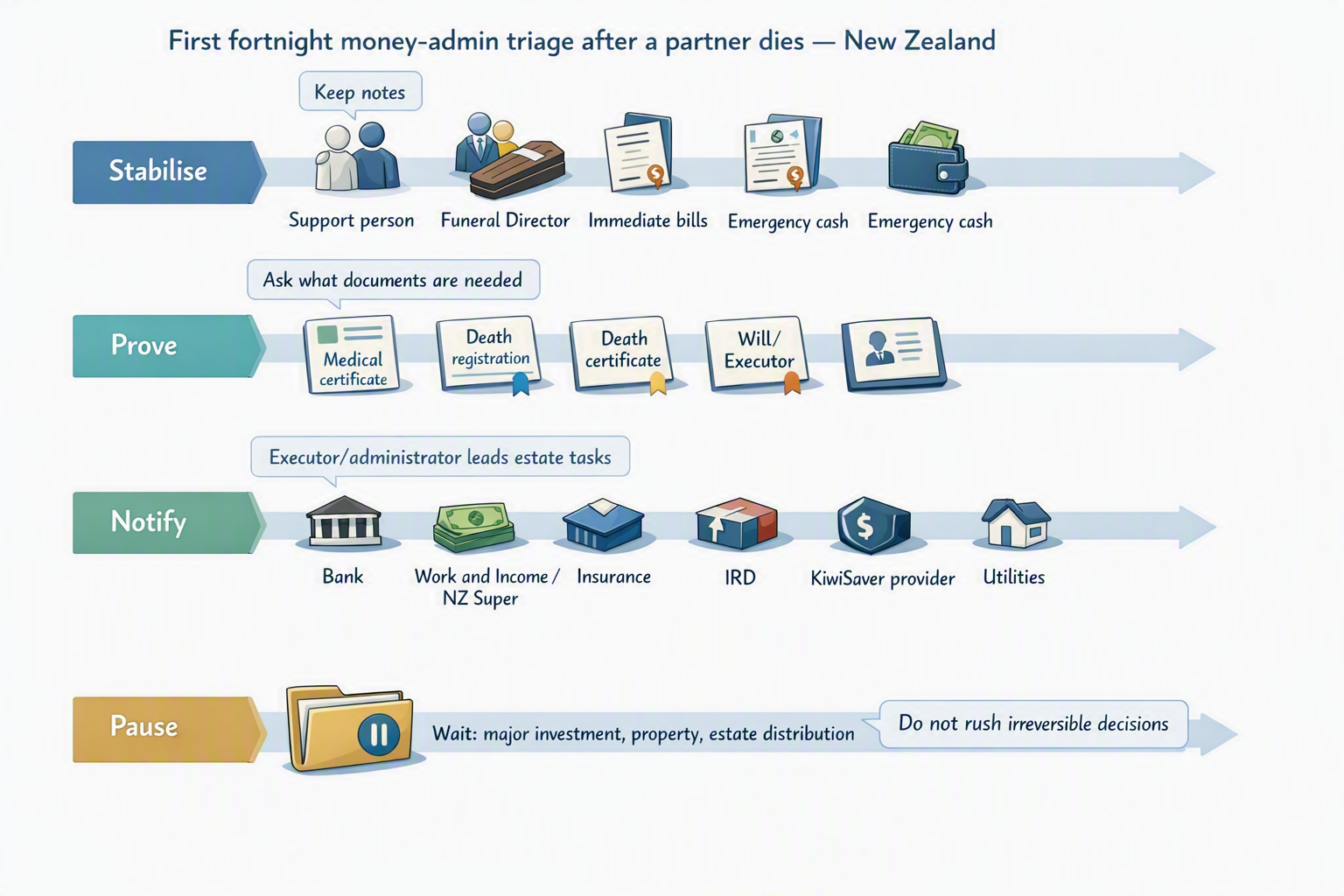
Figure 1: A simple triage map for the first fortnight after a partner dies in New Zealand: stabilise cashflow, gather authority documents, notify key organisations, and park less urgent decisions until after the immediate shock.
1. The first job: find the will and identify who can act
One of the earliest practical questions is: who is legally allowed to deal with the estate? If there is a will, it names the executor — the person responsible for carrying out the will and dealing with the estate. If there is no will, the person dealing with the estate is called an administrator, usually a family member, and they may need to apply for letters of administration.
This matters because banks and other organisations may not be able to take instructions from “next of kin” alone. The Banking Ombudsman explains that banks can take instructions about a deceased person’s accounts only from someone authorised to act for the estate, and that a bank’s duty of confidence to its customer continues after death. That can be frustrating when you are the surviving partner, but it is designed to protect the estate and the people entitled to it.
If you cannot find the will, start with the obvious places: home files, the family lawyer, a trustee company, or anyone your partner may have told. New Zealand Government guidance specifically recommends checking whether the person who died had told someone where their will was, and also points to the Ministry of Justice and Citizens Advice Bureau for help finding a will.
2. Death certificates: the document everyone asks for, but not always immediately
Many organisations will ask for a death certificate before they change ownership, close accounts, release information, or pay a claim. Government guidance says you might need a death certificate when administering an estate or applying for a funeral grant from Work and Income or ACC.
If you use a funeral director, they usually register the death with Births, Deaths and Marriages. If you are organising the funeral and burial yourself, you must register the death yourself within 3 working days of the burial or cremation. It is free to register a death, but there is a fee to order a death certificate. As at the Government page updated 18 June 2026, an official New Zealand death certificate costs $35, and most people receive certificates in 1–2 weeks.
A practical tip: ask each institution whether it needs an original, a certified copy, or a scanned copy. Some insurers, for example, may accept an uploaded copy of the death certificate rather than a certified copy. Keep a running note of who has received what, because during grief it is very easy to lose track.
3. Banking: joint accounts and sole accounts are not the same
Banking is often the most urgent financial task because household bills continue. The key distinction is between joint accounts and accounts held in the deceased person’s sole name.
The Banking Ombudsman says a bank will freeze a deceased customer’s individual accounts when notified of the death, including transactional accounts, term deposits, credit cards and loans. The bank may ask for identification from the person notifying it and a copy of the death certificate. By contrast, joint personal accounts are usually transferred into the remaining account holder’s name, although things may be more complicated where there is debt, such as a loan secured by a mortgage. Joint accounts are not usually blocked and the remaining joint party or signatories can continue to operate the account; however joint loans or joint credit cards may require affordability checks before the deceased customer is removed.
The mistake to avoid is continuing to use a card, online banking login, or signing authority as if nothing has changed. The Banking Ombudsman notes that when a customer dies, all signing authorities on that person’s accounts and any power of attorney authority are no longer valid. If you are worried about funeral costs, mortgage payments, rates, insurance or groceries, call the bank’s bereavement or estates team and ask what support or payment options exist before making withdrawals from an account that is not legally yours to operate.
4. NZ Super and Work and Income: notify early to avoid overpayments
For retirees, NZ Super can be one of the most immediate cashflow changes. If your partner was getting NZ Super or a Veteran’s Pension, you must notify Work and Income if they die; if payments continue when they should not, you may have to pay money back. Work and Income provides an online form to register the death of someone who was receiving New Zealand Superannuation or a Veteran’s Pension.
If you are the surviving partner and you also qualify for NZ Super, Work and Income says your payment will change to a single rate and they will send a letter confirming the new payment amount. Work and Income may also keep a deceased client’s payments going for 28 days, or pay them into the partner’s account instead, depending on the circumstances and any ACC survivor’s grant.
If funeral costs are a concern, it is worth checking support options quickly. Government guidance says a Funeral Grant may help pay reasonable funeral, cremation and burial costs when the deceased’s estate cannot pay, and you do not have to be on a benefit to qualify, although criteria apply.
5. Insurance: notify, ask what documents are needed, and check ownership
Insurance can be a source of relief, but it can also be delayed if no one can find the policy, the ownership is unclear, or the insurer does not yet have the documents it needs. Start by identifying life insurance, funeral insurance, health insurance, house and contents cover, vehicle insurance and any policies attached to a mortgage, credit card or employer scheme.
State Insurance’s bereavement form shows the sort of process insurers may use: they usually work with the executor or administrator, a legal representative acting for the estate, or other policyholders on jointly held policies. For all policies a copy of the death certificate is needed to update the deceased’s policies, and for home insurance without other policyholders it may need probate or letters of administration to show who the property passes to.
For life insurance, ask three questions: Who owns the policy? Who is nominated to receive the money, if anyone? And does the payout go to the estate or outside it? Where insurance is tied to the estate, probate or estate authority may affect timing. This is one reason couples should review policy ownership and nominations before they are needed, not during bereavement.
6. KiwiSaver: it does not automatically go to the surviving partner
KiwiSaver is often misunderstood. When a KiwiSaver member dies, their KiwiSaver funds become part of their estate, and it is not possible to nominate people to receive those funds directly from the KiwiSaver provider. If there is a will, the KiwiSaver provider pays the balance to the estate and the funds are distributed accordingly; if there is no will, an application may need to be made to the New Zealand court to appoint someone to manage the estate.
The balance can affect how quickly funds are released. If the KiwiSaver account balance is under $40,000, an authorised person such as a partner, children, or someone caring for children can apply for the funds without requiring probate or letters of administration; if the balance is over $40,000, the executor will need to apply for probate before the provider can release funds to the estate. Community Law explains that some institutions can transfer money owing to the deceased up to $40,000 without probate or letters of administration, but they are not compelled to do so and may still require documents such as a death certificate.
In the first fortnight, you do not need to “solve” KiwiSaver. You do need to identify the provider, tell the executor, and ask the provider what documents will be required.
7. IRD, myTrove and utilities: reduce repeated conversations
One of the hardest parts of early bereavement is repeating the same painful information to many organisations. myTrove is a free New Zealand service that can notify multiple organisations of a death, including government agencies, banks, insurers and utilities providers. Inland Revenue says myTrove can be used to notify IRD of a death, finalise tax obligations, and, if chosen, notify the Department of Internal Affairs for passports, some banks and insurers, and other organisations.
IRD will need proof you can act for the person who died if you want to send or receive information on their behalf. That proof may be written confirmation such as letters of administration, a copy of the will, or probate. IRD also says you should contact the KiwiSaver scheme provider directly to claim KiwiSaver funds that IRD does not hold.
For utilities, the first question is practical: is the service still needed? Electricity, phone, internet, rates, insurance, subscriptions and streaming accounts may need to be transferred, cancelled or left running temporarily. myTrove specifically lists utilities as organisations that can be advised to disconnect or transfer accounts.
8. What can usually wait beyond the first fortnight
Some things feel urgent because they are important, but they are not necessarily first-fortnight tasks. Probate is a good example. New Zealand Government guidance says probate or letters of administration usually take 6 to 8 weeks and may take longer during busy times. It also says simple estates can take up to 6 months to handle, while complex estates often take longer.
Final tax returns, estate income tax returns, property transfers, investment changes, selling the family home, distributing inheritances and closing every account are generally estate administration tasks, not first-fortnight emergency tasks. The Ministry of Justice explains that an estate includes assets such as a house or land, bank accounts and investments, vehicles and household items, and also includes debts and bills, which must be paid before remaining property and money are distributed.
The emotional rule is simple: do not make irreversible financial decisions while you are in shock unless a trusted professional confirms there is a genuine deadline. The first fortnight is a time for information gathering, not for redesigning your whole life.
9. The common traps surviving partners face
The first trap is assuming that being the surviving partner automatically gives you authority over everything. It does not. Banks may only take instructions from the executor or administrator for estate accounts, KiwiSaver usually flows through the estate, and insurers may require proof of entitlement depending on policy ownership.
The second trap is losing access to money because all income, bills or cards were organised in one person’s name. Joint accounts may continue, but sole accounts can be frozen, and additional cardholders may lose access when the principal cardholder dies. For retirees, the change from couple-based household cashflow to a single-person reality can also require a quick budget reset, particularly when NZ Super payment settings change. [govt.nz]
The third trap is trying to be efficient by doing everything at once. Grief affects memory, energy and decision-making. Government guidance explicitly encourages people to ask others for help with the practical and administrative load, while recognising that executors and administrators must still lead certain legal tasks.
10. How couples can make this kinder before it happens
The kindest administrative gift you can leave your partner is clarity. Government guidance recommends creating a plan, preparing financially, organising affairs, leaving funeral or memorial instructions, and storing wills and EPAs safely. It also says a will gives loved ones clarity while they grieve and is clearer and easier to handle than having no will.
At minimum, couples should know where to find: wills, enduring powers of attorney, insurance policies, KiwiSaver provider details, bank and investment accounts, mortgage or loan documents, rates and utility accounts, adviser contacts, lawyer contacts, accountant contacts, and funeral wishes. Health New Zealand also notes that an up-to-date will can make the process smoother for whānau and help avoid drawn-out processes or disputes, and that an EPA appoints someone to make decisions if you become unable to do so.
Digital life matters too. Government guidance says organising digital accounts and assets is an act of love because they can otherwise be frustrating for loved ones to deal with. InternetNZ recommends making a plan for online accounts, using a password manager, backing up important documents and family photos, and not simply placing online banking details in a handover folder because the executor should deal with banks properly.
For Athena Wealth clients, this preparation fits naturally into broader life-journey planning. Athena describes financial planning as bringing your dreams and reality together, working with other professional advisers, and reviewing plans as circumstances change. Internally, Athena’s own checklist also asks whether clients have an estate plan that reflects their intentions, a living will, property and personal care EPAs, and whether circumstances have changed enough to update those documents.
Final thought: you are not meant to know all of this alone
The fortnight after your partner dies is not a test of competence. It is a human moment, and most people are learning the process at the worst possible time.
If you are in that fortnight now, do the next right thing: find the will, identify the executor, secure day-to-day cashflow, ask for the death certificate, notify the bank and Work and Income, locate insurance and KiwiSaver details, and keep a notebook. Everything else can be worked through step by step.
If you are reading this before you need it, take it as an invitation to make life easier for the person you love. Put the documents in one place. Talk through how the bills are paid. Check account ownership. Update your will and EPAs. Write down the names of your advisers. A financial plan is not just about investments; it is about making your life — and eventually your partner’s life — easier to navigate.
Athena Wealth is an independent, fee-based financial planning firm committed to helping New Zealanders make informed decisions and build lasting financial security. We do not replace your lawyer, accountant or trustee company, but we can help you understand the financial picture, organise the questions to ask, and build a plan that is resilient before life becomes urgent.
This article is general information only and is not personalised financial, legal or tax advice. Estate administration, probate, insurance claims and tax matters depend on your circumstances, so please seek advice from a lawyer or a trustee company before acting. Government guidance also notes that wills, estates and financial planning information is not legal or financial advice and that people should seek help from a lawyer, trustee company or financial adviser where needed.